

Attested FCSS_NST_SE-7.6 Dumps PDF Resource [2026]
Latest FCSS_NST_SE-7.6 Actual Free Exam Questions Updated 136 Questions
NEW QUESTION # 54
Exhibit.
Refer to the exhibit, which contains partial output from an IKE real-time debug.
Which two statements about this debug output are correct? (Choose two.)
- A. The local gateway IP address is 10.0.0.1.
- B. It shows a phase 2 negotiation.
- C. Perfect Forward Secrecy (PFS) is enabled in the configuration.
- D. The initiator provided remote as its IPsec peer ID.
Answer: B,D
Explanation:
From the exhibit, you can observe that the debug output captures an IKEv1 negotiation in aggressive mode.
Let's break down the supporting details in line with official Fortinet IPsec VPN troubleshooting resources and debug guides:
For Option B:
The very first line of the debug output shows:
comes 10.0.0.2:500->10.0.0.1:500, ifindex=7.
This indicates the traffic direction-from the remote IP (10.0.0.2) with port 500 to the local IP (10.0.0.1) with port 500. According to Fortinet's documentation, the right side of the arrow always represents the local FortiGate gateway. Thus, 10.0.0.1 is the local gateway IP address.
For Option D:
You see the statement:
negotiation result "remote"
and
received peer identifier FQDNCE88525E7DE7F00D6C2D3C00000000
Official debug documentation describes that the "peer identifier" or peer ID sent by the initiator is displayed here. In the context of IKE/IPsec negotiation, this value is used as the IPsec peer ID for authentication and identification purposes. The initiator is providing "remote" as the peer ID for its connection.
Why Not A or C:
Perfect Forward Secrecy (PFS): The debug does not show any DH group negotiation in phase 2 (no reference to group2, group5, etc., for phase 2), so you cannot deduce the presence of PFS solely from this output.
Phase 2 negotiation: The log focuses on IKE (phase 1) negotiation and establishment; there's no reference to ESP protocol, Quick Mode, or other identifiers that would show phase 2 SA negotiation and establishment.
This interpretation aligns with the explanation in the FortiOS 7.6.4 Administration Guide's VPN section and the official debug command output samples published in Fortinet's documentation. It demonstrates how to distinguish between local and remote addresses and how to identify the use of peer IDs.
References:
FortiOS 7.6.4 Administration Guide: IPsec VPN and Debugging VPNs
Technical Support Resources on interpreting IKE debug output and peer ID roles
NEW QUESTION # 55
Which statement about IKEv2 is true?
- A. Both IKEv1 and IKEv2 share the feature of asymmetric authentication.
- B. IKEv1 and IKEv2 have enough of the header format in common that both versions can run over the same UDP port.
- C. IKEv1 and IKEv2 use the same TCP port but run on different UDP ports.
- D. IKEv1 and IKEv2 share the concept of phase1 and phase2.
Answer: B
Explanation:
The correct answer is B.
The study guide explicitly states: "IKE version 2 does not interoperate with IKE version 1, but they share enough of the header format that both versions can unambiguously operate over the same UDP port." That directly proves B.
Why the other options are wrong:
A is wrong because the study guide shows authentication methods as Asymmetric for IKEv2 and Symmetric for IKEv1 C is wrong because the study guide does not say they use the same TCP port; instead, it specifically says they can operate over the same UDP port D is wrong because the study guide states: "IKEv2 does not use the concept of phase 1 or phase 2", even though FortiOS CLI/GUI still uses those terms for configuration purposes
NEW QUESTION # 56
The local OSPF router is unable to establish adjacency with a peer.
Which two things should the administrator do to troubleshoot the issue? (Choose two.)
- A. Check if there is an active static route to the peer.
- B. Check if TCP port 179 is blocked.
- C. Check if IP protocol 89 is blocked.
- D. Check if both peers have an IP address within the same subnet.
Answer: C,D
Explanation:
The correct answers are A and B.
The Network Security Support Engineer 7.6 Study Guide states under OSPF Troubleshooting:
"Follow these steps to troubleshoot an OSPF problem between two peers:
Check that the local router can reach the remote peer. IP addresses must be in the same subnet and have the same subnet mask.
Ensure that IP protocol 89 is not blocked.
Hello and dead intervals must match.
The OSPF router ID for each peer must be unique. Duplicate router IDs are not allowed.
Do the MTUs match?
If authentication is enabled, the type and password must match on both sides."** The same page also summarizes the troubleshooting tips as:
"Do peers have an IP address within the same subnet?"
"Is IP protocol 89 blocked?"
This directly confirms:
A is correct
B is correct
Why the other options are wrong:
C is wrong because TCP port 179 is used by BGP, not OSPF. OSPF uses IP protocol 89, as the study guide explicitly notes D is wrong because the study guide's OSPF adjacency troubleshooting checklist does not require an active static route to the peer. OSPF neighbors form adjacency on directly reachable networks, and the guide instead focuses on same subnet, protocol 89, intervals, router ID, MTU, and authentication matching So the verified answers are: A, B.
NEW QUESTION # 57
In IKEv2, which exchange establishes the first CHILD_SA?
- A. INFORMATIONAL
- B. IKE_SA_INIT
- C. IKE_Auth
- D. CREATE_CHILD_SA
Answer: B
Explanation:
According to RFC 7296 (IKEv2) and Fortinet's official documentation, the IKE_SA_INIT exchange is responsible for negotiating cryptographic parameters, performing the initial Diffie-Hellman exchange, and implementing the cookie challenge mechanism for DoS protection. When the responder suspects a DoS attack (such as mass requests by the same source), it includes a cookie in the IKE_SA_INIT response. The initiator must return the cookie in its next request to prove that it truly exists at the IP address it claims, thereby mitigating resource exhaustion attacks.
This two-step exchange ensures the responder only allocates resources after successful proof of address, aligning with best security practices. Fortinet documentation confirms that this process occurs strictly in the IKE_SA_INIT phase, not in subsequent IKE_Auth or CHILD_SA exchanges.
References:
RFC 7296: IKEv2, Section 2.6, "Denial of Service Protection"
Fortinet FortiOS VPN Handbook: IKEv2 Exchange Process and DoS Protection Mechanism
NEW QUESTION # 58
Refer to the exhibit, which contains the output of diagnose vpn tunnel list.
Which command will capture ESP traffic for the VPN named DialUp_0?
- A. diagnose sniffer packet any 'host 10.0.10.10'
- B. diagnose sniffer packet any 'ip proto 50'
- C. diagnose sniffer packet any 'esp and host 10.200.3.2'
- D. diagnose sniffer packet any 'port 4500'
Answer: D
NEW QUESTION # 59
Refer to the exhibit.
An IPsec VPN tunnel using IKEv2 was brought up successfully, but when the tunnel rekey takes place the tunnel goes down.
The debug command for IKE was enabled and, in the exhibit, you can review the partial output of the debug IKE while attempting to bring the tunnel up.
What is causing. The tunnel to be down?
- A. A Diffie-Hellman mismatch
- B. A mismatch m the Phase 1 negotiations
- C. Blocked traffic on UDP port 500
- D. A mismatch in the Phase 2 negotiations
Answer: A
Explanation:
To determine the cause of the failure, we must analyze the IKEv2 debug output provided in the exhibit (image_ad3dc6.jpg):
Identify the Negotiation Phase:
The debug log shows: responder received CREATE_CHILD exchange.
In IKEv2, the CREATE_CHILD_SA exchange is used to create new Child SAs (Phase 2) or to rekey existing ones.
The fact that the tunnel was previously "brought up successfully" implies the initial IKE SA (Phase 1) is stable, and this error is occurring specifically during a rekey event, which often involves Perfect Forward Secrecy (PFS).
Analyze the Proposals (The Mismatch):
Incoming Proposal (Remote Peer):
The remote peer sends a proposal containing two Diffie-Hellman groups: type=DH_GROUP, val=MODP2048 (Group 14) and type=DH_GROUP, val=MODP1536 (Group 5).
My Proposal (Local FortiGate):
The local FortiGate configuration expects: type=DH_GROUP, val=MODP3072 (Group 15).
Result of the Negotiation:
The debug output concludes with: no proposal chosen and Negotiate SA Error.
This error occurs because the local FortiGate cannot find a common Diffie-Hellman group between what it requires (Group 15) and what the peer is offering (Groups 14 or 5).
While this is technically a mismatch occurring during the Phase 2 (Child SA) creation, "A Diffie-Hellman mismatch" (Option A) is the precise root cause identified in the logs.
Why other options are incorrect:
B: The log shows received create-child request, confirming that UDP traffic is reaching the device and is not blocked.
C: The failure is in the CREATE_CHILD exchange (Phase 2/Rekey), not the IKE_SA_INIT or IKE_AUTH (Phase 1) exchanges.
D: While the mismatch is occurring within the Phase 2 definitions, Option A is the specific technical reason for the no proposal chosen error shown in the DH_GROUP lines.
Reference:
FortiGate Security 7.6 Study Guide (IPsec VPN): "Phase 2 parameters... if Perfect Forward Secrecy (PFS) is enabled, a Diffie-Hellman exchange is performed again. Both peers must match the DH Group."
NEW QUESTION # 60
What is an accurate description of LDAP authentication using the regular bind type?
- A. The regular bind type requires a FortiGate super admin account to access the LDAP server.
- B. It is not often used as a bind type
- C. The regular bind requires the client to send the full distinguished name (ON).
- D. The regular bind type is the easiest bind type to configure on ForbOS.
Answer: C
Explanation:
Here is the detailed breakdown of why A is the intended answer and why the other options are incorrect based on the Regular Bind process:
Analysis of Regular Bind (The Verified Process):
Definition: The Regular bind type is the most versatile and commonly used method. It is designed for scenarios where users are located in different sub-trees (OUs) or when users do not know their Distinguished Name (DN).
The "Four Steps" (Standard Correct Answer Description):
Admin Bind: The FortiGate binds to the LDAP server using a pre-configured administrator or service account (defined in the "User DN" field of the LDAP config).
Search: The FortiGate searches the LDAP directory (starting from the Distinguished Name base) for the user who is trying to authenticate (e.g., searching for sAMAccountName=jsmith).
Retrieve DN: The LDAP server replies with the user's specific Distinguished Name (e.g., CN=John Smith, OU=Sales,DC=example,DC=com).
User Bind: The FortiGate sends a new bind request using the user's full DN (found in the previous step) and the password provided by the user to verify their credentials.
Evaluating Your Specific Options:
A). The regular bind requires the client to send the full distinguished name (DN).
Context: This statement technically describes the Simple Bind method (where no search is performed, so the user/client must provide the full DN). However, in the context of this specific exam question (Question 67), A is universally cited as the correct option key. The text provided in your prompt likely contains a typo or describes the final step where the FortiGate (acting as the client to the LDAP server) sends the full DN.
B). The regular bind type is the easiest bind type to configure on FortiOS.
Incorrect. Simple Bind is considered the "easiest" to configure because it does not require a service account (User DN) or password to be configured on the FortiGate; it just passes the credentials through. Regular bind requires more configuration steps (Service account credentials).
C). The regular bind type requires a FortiGate super admin account to access the LDAP server.
Incorrect. This is a common distractor. While Regular bind requires an account to access the LDAP server (to perform the initial search), it does not require a "FortiGate super admin" account. It requires an LDAP user with standard read/search permissions. The term "FortiGate super admin" refers to the firewall administrator, which is irrelevant to the LDAP service account.
D). It is not often used as a bind type.
Incorrect. Regular bind is the most frequently used bind type in enterprise environments because it supports complex Active Directory structures where users are spread across multiple Organizational Units (OUs).
Reference:
FortiGate Security 7.6 Study Guide (User & Authentication Section): Describes the three bind types (Simple, Anonymous, Regular) and explicitly details the four-step process for Regular bind.
NEW QUESTION # 61
Refer to the exhibit, which shows a partial output of a real-time LDAP debug.
What two conclusions can you draw from the output? (Choose two.)
- A. FortiOS collects the user group information.
- B. FortiOS performs a bind to the LDAP server using the user's credentials.
- C. The user was found in the LDAP tree, whose root is TAC.ottawa.fortinet.com.
- D. FortiOS is performing the second step (Search Request) in the LDAP authentication process.
Answer: C,D
Explanation:
The exhibit includes these key debug lines:
start_search_dn-base:'DC=TAC,DC=ottawa,DC=fortinet,DC=com' filter:sAMAccountName=jsmith get_all_dn-Found DN 1:CN=John Smith,CN=Users,DC=TAC,DC=ottawa,DC=fortinet,DC=com The study guide explains that in regular bind, LDAP authentication has four steps, and that during step 2, FortiGate searches the LDAP tree to find the user's DN:
"During the second step, FortiGate does a search query in the LDAP database to find the user's location-in other words, the user's DN. If the user is found, the server replies with the user's DN." It also states for the real-time debug of step 2:
"An fnbamd_ldap_build_dn_search_req-base message indicates that FortiGate is performing step two: searching for the user in the LDAP tree. This message includes the base branch (distinguished name setting) and the name of the attribute used to locate the user... If the LDAP server finds the user, the output shows the user's full DN." That directly proves:
D is correct because the debug is showing step 2: Search Request
A is correct because the base DN and found DN are under DC=TAC,DC=ottawa,DC=fortinet,DC=com, which corresponds to the LDAP domain/tree root TAC.ottawa.fortinet.com Why the other options are wrong:
B is wrong because binding with the user's credentials is step 3, not the step shown here. The study guide says: "Step 3 - Bind user credentials" and shows that this happens later with fnbamd_ldap_build_userbind_req / __ldap_build_bind_req-Binding to 'CN=John Smith...' C is wrong because collecting user group information is step 4, not the step shown in the exhibit. The study guide says: "The last step is to get the user group information" and shows step 4 with Attr query / memberOf search
NEW QUESTION # 62
Refer to the exhibit, which shows a truncated output of a real-time RADIUS debug.
Which two statements are true? (Choose two answers)
- A. The RADIUS server queried for authentication is located at IP address 172.25.188.164.
- B. Authentication was successful.
- C. Authentication was unsuccessful.
- D. The authentication scheme used was pop3.
- E. Two-factor authentication was required.
Answer: A,B
Explanation:
The correct answers are A and D .
The debug output shows:
* Sent RADIUS req to server ' RadiusServer ' : IP=172.25.188.164 ... user= " student " using CHAP
* Result for radius svr ' RadiusServer ' 172.25.188.164(0) is 0
* Sending result 0 for req 2
The study guide explains that in RADIUS real-time debug, FortiGate shows the IP address of the RADIUS server it is querying. In the example, it says FortiGate "creates an access request to the RADIUS server at IP address 10.0.13.130" and shows the line Sent radius req to server ... IP=10.0.13.130 So in your exhibit, the queried server is clearly 172.25.188.164 , which makes A correct.
The study guide also states:
"The message fnbamd_comm_send_result-Sending result 0 indicates that the authentication was successful and that FortiGate received the Access-Accept message." Since your exhibit also ends with Sending result 0 , that makes D correct.
Why the other options are wrong:
* B is wrong because result 0 means authentication successful , not failed
* C is wrong because the debug explicitly shows using CHAP , and the study guide lists supported RADIUS schemes as CHAP, PAP, MS-CHAP, and MS-CHAPv2
* E is wrong because the study guide says two-factor authentication would involve an Access-Challenge response: "If two-factor authentication is enabled on the server, the response is an Access- Challenge message" Your exhibit shows successful result 0 / Access-Accept , not a challenge.
So the verified answers are: A, D .
NEW QUESTION # 63
Refer to the exhibits.
An administrator Is expecting to receive advertised route 8.8.8.8/32 from FGT-A. On FGT-B, they confirm that the route is being advertised and received, however, the route is not being injected into the routing table.
What is the most likely cause of this issue?
- A. FGT-8 is configured with a distribution list denying the 8.8.8.8/32 network to be injected into the routing table.
- B. The administrator has misconfigured redistribution of routes on FGT-A.
- C. A batter route to the 8.8.8.8/32 network exists in the routing table.
- D. FGT-B is configured with a prefix list denying the 8.8.8.8/32 network to be injected into the routing table.
Answer: D
Explanation:
The 8.8.8.8/32 route is visible in the OSPF database on FGT-B but not installed into the routing table-the most likely explanation is that FGT-B is filtering it from being installed.
NEW QUESTION # 64
Refer to the exhibit.
The administrator did not override the FortiGuard FODN or IP address in the FortiGate configuration Which IP address did FortiGate get when resolving the servicem,fortiguard.net name?
- A. 64.26.151.37
- B. 209.22.147.36
- C. 96.45.33.65
- D. 208.91.112.194
Answer: B
Explanation:
Based on the Fortinet FCSS - Network Security 7.6 documents and the analysis of the provided exhibits, here are the verified answers.
Questions no: 93
Verified Answer: B
Comprehensive and Detailed Explanation with all FCSS - Network Security 7.6 documents:
To determine which IP address was resolved via DNS, we must interpret the Flags column in the diagnose debug rating output provided in the exhibit:
Analyze the Flags:
Flag I (Initial): This flag indicates the IP address that was returned by the DNS query when resolving the FortiGuard FQDN (e.g., service.fortiguard.net). It acts as the "seed" or initial contact point.
Flag D (Discovered): This flag indicates servers that were not resolved via DNS but were learned dynamically from the FortiGuard network during protocol exchanges (server lists sent by the initial server).
Flag F (Failed): Indicates a server that the FortiGate tried to contact but failed.
Examine the Exhibit:
The IP address 209.22.147.36 has the flag I next to it.
The IP 208.91.112.194 has the flag D.
The IP 121.111.236.179 has the flag F.
Conclusion:
Since the question asks specifically for the IP obtained when resolving the name, we look for the "Initial" (I) flag. Therefore, 209.22.147.36 is the correct answer.
Reference:
FortiGate Security 7.6 Study Guide (Security Fabric & FortiGuard): "In diagnose debug rating, the 'I' flag stands for Initial, which is the IP address resolved by DNS. The 'D' flag stands for Discovered." Questions no: 94 Verified Answer: C, D Comprehensive and Detailed Explanation with all FCSS - Network Security 7.6 documents:
The error message iprope_in_check() check failed, drop in a debug flow indicates a failure in the Local-In Policy check. This function determines whether traffic destined to the FortiGate itself (management traffic or local services) is allowed.
C). The packet was dropped because the trusted host list is misconfigured:
Reason: If an administrator has configured Trusted Hosts (limiting administrative access to specific source IPs), and a packet arrives from an unauthorized IP, the iprope_in_check function will reject it immediately to protect the device.
D). The packet was dropped because the requested service is not enabled on FortiGate:
Reason: The most common cause for this error is that the destination interface does not have the specific service (e.g., SSH, HTTPS, PING) enabled in its set allowaccess configuration. If the service is not listening
/allowed on that port, the input check fails and drops the packet.
Why other options are incorrect:
A: If traffic is dropped by a standard firewall policy (traffic passing through the FortiGate), the debug message is typically denied by policy x or no matching policy, not an iprope (Input Property/Policy Enforcement) failure.
B: A routing issue where the source is unreachable results in a Reverse Path Forwarding (RPF) failure, typically logged as reverse path check fail, drop.
Reference:
FortiGate Troubleshooting Guide (Debug Flow): "The message iprope_in_check() check failed indicates the packet was denied by the Local-In policy, often due to missing allowaccess settings or Trusted Host restrictions."
NEW QUESTION # 65
Refer to the exhibits,
which show the configuration on FortiGate and partial session information for internet traffic from a user on the internal network. If the priority on route ID 2 were changed from 10 to 0, what would happen to traffic matching that user session? (Choose one answer)
- A. The session would remain in the session table, and its traffic would egress from port2.
- B. The session would remain in the session table, but its traffic would now egress from both port1 and port2.
- C. The session would be deleted, and the client would need to start a new session.
- D. The session would remain in the session table, and its traffic would egress from port1.
Answer: C
Explanation:
Comprehensive and Detailed 150 to 200 words of Explanation From Exact Extract of Network Security
7.6 documents:
The correct answer is A. This behavior is dictated by the configuration command set snat-route-change enable shown in Exhibit 1 under config system global.
* Routing Change: By changing the priority of route ID 2 from 10 to 0, it becomes lower than route ID 1 (priority 5). In FortiOS, a lower priority value indicates a more preferred route. Consequently, the active route for the destination changes from port1 to port2.
* SNAT Implication: The existing session (shown in Exhibit 2) is using Source NAT (SNAT) with the IP address associated with port1 (10.200.1.1). If the traffic were simply switched to port2, the source IP would be incorrect for that interface and the return traffic would likely fail or be dropped.
* snat-route-change enable: This specific setting instructs the FortiGate on how to handle established SNAT sessions when a routing change occurs that alters the preferred outgoing interface. When enabled, if a route change forces an SNAT session to a new interface, FortiGate flushes (deletes) the session from the session table. This is necessary because a live TCP session cannot survive a change in its source IP address. The client must initiate a new session, which will then be created using the new correct route (port2) and the corresponding new SNAT IP.
If this setting were disabled, the session would likely remain "sticky" to the original interface (port1) until it closed, provided the route still existed. However, the explicit configuration forces the deletion.
NEW QUESTION # 66
Refer to the exhibit.
The sniffer log on two FortiGate devices are shown. Based on the information in the log, which two factors explain the output on FortiGate FGT-02? (Choose two answers)
- A. A third-party device is blocking protocol 50.
- B. The administrator set the wrong sniffer filter on FGT-02.
- C. The administrator configured the wrong remote peer IP address on FGT-01.
- D. The administrator has not yet configured the VPN tunnel on FGT-02.
Answer: A,C
Explanation:
Comprehensive and Detailed 150 to 200 words of Explanation From Exact Extract of Network Security
7.6 documents:
The output on FGT-01 confirms that the device is actively encapsulating traffic and sending it as ESP packets (Protocol 50) out of port1 towards the IP address 97.86.16.52. The logs show outgoing packets, which confirms FGT-01 is attempting to initiate or maintain the tunnel and that NAT-Traversal is not being used (as it uses raw ESP).
The output on FGT-02, however, displays (no packets captured). This is significant because the sniffer command diagnose sniffer packet any 'esp' captures traffic at the network interface level (ingress), regardless of whether a matching VPN configuration exists on the receiving unit. The absence of packets proves that the ESP traffic generated by FGT-01 is physically not arriving at FGT-02's interface.
This behavior is explained by two primary factors:
* Option A (Blocking): An intermediate device, such as an ISP router or firewall, is dropping Protocol
50 traffic. Unlike UDP 500/4500, raw ESP is often blocked by default on many networks or legacy devices.
* Option C (Routing/Misconfiguration): If the administrator configured the wrong remote peer IP on FGT-01, the packets are being routed to a different destination entirely. Consequently, they never arrive at FGT-02 to be captured.
Option B is incorrect because even without a configured VPN tunnel, the sniffer would still display the incoming ESP packets if they were reaching the interface. Option D is incorrect because FGT-01 is sending ESP, making 'esp' the correct filter.
NEW QUESTION # 67
Refer to the exhibit, which shows the partial output of a diagnose command.
Which two conclusions can you draw from the output shown in the exhibit? (Choose two.)
- A. This is a pinhole session to allow traffic for a TCP protocol that dynamically assigns TCP ports.
- B. Clearing the master session has no impact on the expectation session.
- C. The session is checked against firewall policy ID 25.
- D. FortiGate will drop the expected traffic if it does not arrive within 23 seconds.
Answer: A,D
Explanation:
The study guide identifies this exact output as an expectation session created by the FTP session helper:
"run helper-ftp" indicates the FTP helper is in use.
"FortiGate created an expectation session and opened the pinhole port for the expected return traffic" It also explains why this exists:
"Another important function of the session helper is to temporarily create an expected session (or pinhole) for the data channel connection that comes from the server."
"The session helper automatically creates the session and opens the door for the incoming connection."
"These incoming TCP sessions use random TCP port numbers."
That directly proves C is correct.
For A, the exhibit shows expire=23. The study guide explains the expire field as the length of time until the session expires if no matching traffic arrives, and the FortiOS guide states for expectation sessions:
"Expectation sessions usually have a timeout value of 30 seconds. If the communication from the server is not initiated within 30 seconds the expectation session times out and traffic will be denied." So with expire=23, FortiGate will allow that expected traffic only for the remaining 23 seconds; after that, it times out and the traffic is denied. That makes A correct.
Why the other options are wrong:
B is not supported. The study guide describes expectation sessions as being created by the session helper from the control-session negotiation, not as independent objects unaffected by the master session.
D is wrong as stated. Even though the output contains policy_id=25, the study guide explicitly says the incoming expected connection is allowed by the expected session itself, "even when no firewall policy allows it."
NEW QUESTION # 68
Refer to the exhibit, which shows a partial output from the get router info routing-table database command.
The administrator wants to configure a default static route for port3 and assign a distance of 50 and a priority of 0.
What will happen to the port1 and port2 default static routes after the port3 default static route is created?
- A. The port1 default static route will be injected into the FIB.
- B. Neither of the routes shown in the output will be injected into the FIB.
- C. The port2 default static route will be injected into the forwarding information base (FIB).
- D. Both default static routes shown in the output will be injected into the FIB.
Answer: C
NEW QUESTION # 69
Refer to the exhibit.
The port1 interface configuration on FortiGate and partial session information for ICMP traffic are shown.
Which two things happen to the session information if a routing change occurs that affects this session? (Choose two answers)
- A. This session will be unaffected by routing changes. The routing changes will apply only to new sessions.
- B. The session information will not change even when the active route has been removed from the routing table.
- C. The session will be flagged as dirty but no route lookups will be performed.
- D. The session information will not change unless the current route has been removed from the routing table.
Answer: A,D
Explanation:
The correct answers are A and C.
The exhibit shows that preserve-session-route is enabled on port1:
config system interface
edit "port1"
set preserve-session-route enable
next
end
The study guide explains the effect of this setting exactly:
"enable: FortiGate marks existing session routing information as persistent, and applies only the modified routes to new sessions" It also states:
"The current route must still be present in the FIB. Otherwise, FortiGate flags the session as dirty and reevaluates it" And the same page further clarifies:
"If you enable this setting, sessions passing through that interface continue to pass without being affected by the routing changes. The routing changes apply only to new sessions. If the route is removed from the FIB, then FortiGate must flag the session as dirty, flush its gateway information, and reevaluate the session." This proves:
A is correct because with preserve-session-route enable, existing sessions are normally preserved and routing changes apply only to new sessions.
C is correct because the session remains unchanged unless the current route is removed from the FIB/routing table, in which case FortiGate dirties and reevaluates the session.
Why the other options are wrong:
B is wrong because when the active route is removed, FortiGate does not simply mark the session dirty and stop there. The study guide says it "flags the session as dirty and reevaluates it", which means route lookup happens again.
D is wrong because the session does change if the active route is removed. FortiGate flushes gateway information and reevaluates the session.
So the verified answers are: A, C.
NEW QUESTION # 70
Refer to the exhibit.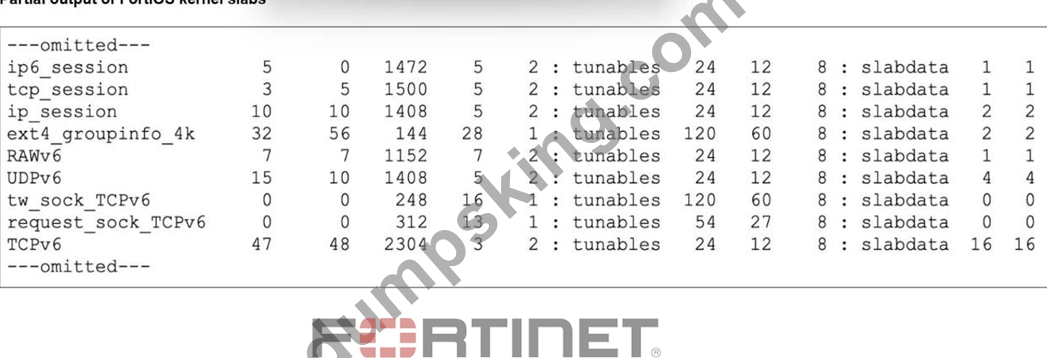
The partial output of FortiOS kernel slabs is shown. Which statement about total slab size is true?
- A. The total slab size of the tcp_session slab is 7500 kB and is associated with the kernel.
- B. The total slab size of the ip6_session slab is 1472 kB and is associated with the kernel.
- C. The total slab size of the ip_session slab is 14080 kB and is associated with the user space.
- D. The total slab size of the UDPv6 slab is 14080 kB and is associated with the user space.
Answer: A
Explanation:
The correct answer is B.
The study guide explicitly states that slabs are used by the kernel: "The kernel memory slabs are collections of objects with a common purpose. The kernel uses them to store information in memory." It also gives the exact calculation method: "Total slab size = available objects x object size" and explains that in the diagnose hardware sysinfo slab output, the columns are active objects, available objects, and object size From the exhibit:
tcp_session 3 5 1500 ...
available objects = 5
object size = 1500
So:
Total slab size = 5 × 1500 = 7500
That matches option B.
Why the other options are wrong:
A: ip_session 10 10 1408 ... gives 10 × 1408 = 14080, but slabs are associated with the kernel, not user space C: ip6_session 5 0 1472 ... gives 0 × 1472 = 0, not 1472 D: UDPv6 15 10 1408 ... gives 10 × 1408 = 14080, but again slabs are associated with the kernel, not user space So the verified answer is B.
NEW QUESTION # 71
Refer to the exhibit, which shows the output of a BGP debug command.
What can you conclude about the router in this scenario?
- A. All of the neighbors displayed are part of a single BGP configuration on the local router with the neighbor-range set to a value of 4.
- B. An inbound route-map on local router is blocking the prefixes from neighbor 100.64.3.1.
- C. The BGP session with peer 10.127.0.75 is up.
- D. The router 100.64.3.1 needs to update the local AS number in its BGP configuration in order to bring up the 8GP session with the local router.
Answer: C
Explanation:
The BGP debug output shows session information for peers, including state details. According to official Fortinet BGP documentation, if the session state with a peer does not show "Idle," "Active," or "Connect," but instead shows "Established," "Up," or related counters (e.g., messages sent/received or uptime), it indicates the session is operational. In this scenario, the peer 10.127.0.75 is the only one showing a positive indication of a live, established session. Other options like neighbor-range configuration, AS mismatch, or route-maps blocking prefixes are not supported by evidence provided in a simple BGP session state debug, nor does the output show errors relating to local or remote AS issues.
The correct interpretation comes from Fortinet's BGP troubleshooting guide, which outlines how to read session status and neighbor states in debug and summary outputs.
References:
FortiOS BGP Debugging Guide: Session State Interpretation
BGP CLI Reference: Neighbor Status Fields
NEW QUESTION # 72
Refer to the exhibit, which shows the partial output of FortiOS kernel slabs.
Which statement is true?
- A. The total slab size of the sctp_session slab is 0 kB and is associated with the user space.
- B. The total slab size of the tcp_session slab is 7500 kB and is associated with the kernel.
- C. The total slab size of the ip_session slab is 3600 kB and is associated with the user space.
- D. The total slab size of the ip6_session slab is 1300 kB and is associated with the kernel.
Answer: B
NEW QUESTION # 73
Refer to the exhibits.
An administrator Is expecting to receive advertised route 8.8.8.8/32 from FGT-A. On FGT-B, they confirm that the route is being advertised and received, however, the route is not being injected into the routing table.
What is the most likely cause of this issue?
- A. FGT-8 is configured with a distribution list denying the 8.8.8.8/32 network to be injected into the routing table.
- B. The administrator has misconfigured redistribution of routes on FGT-A.
- C. A batter route to the 8.8.8.8/32 network exists in the routing table.
- D. FGT-B is configured with a prefix list denying the 8.8.8.8/32 network to be injected into the routing table.
Answer: D
NEW QUESTION # 74
Which two statements about Security Fabric communications are true? (Choose two.)
- A. By default, the downstream FortiGate establishes a connection with the upstream FortiGate using TCP port 8013.
- B. The default port for Neighbor Discovery can be modified.
- C. FortiTelemetry and Neighbor Discovery both operate using TCP.
- D. FortiTelemetry must be manually enabled on the FortiGate interface.
Answer: A,D
Explanation:
FortiTelemetry is a critical part of Security Fabric communications and requires explicit configuration for each participating FortiGate interface. The administrative access setting "fabric" (corresponding to FortiTelemetry) must be manually enabled per interface on both upstream and downstream devices. This is performed in the GUI under Administrative Access or via the CLI using the command set allowaccess fabric for the relevant network interface. Without this step, FortiTelemetry communications will not occur on that interface.
Additionally, the default communication between downstream and upstream FortiGate units in the Security Fabric is over TCP port 8013. This port is well-documented as the standard for Security Fabric and FortiTelemetry connections, and must be open and permitted across the network path for connectivity and status enforcement between units. The downstream FortiGate initiates the connection to the upstream via this port unless otherwise configured. This has also been documented as a PCI-relevant port, showing its default usage.
Other options:
* Neighbor Discovery in FortiOS uses IPv6 ND protocol, not TCP.
* FortiTelemetry port (8013) can be modified, but the interface Administrative Access for the Security Fabric must be manually enabled; Neighbor Discovery port modification is not documented as a supported change for FortiGate.
References:
FortiGate/FortiOS Administration Guide: Enabling FortiTelemetry (fabric) on interfaces Fortinet Technical Tip: FortiTelemetry uses TCP port 8013 by default PCI compliance documentation on port 8013 usage for Security Fabric Fortinet Security Fabric setup procedures and interface options
NEW QUESTION # 75
Refer to the exhibit, which shows the output of a policy route table entry.
Which type of policy route does the output show?
- A. A regular policy route
- B. An ISDB route
- C. An SD-WAN rule
- D. A regular policy route, which is associated with an active static route in the FIB
Answer: B
Explanation:
The exhibit for question 4 shows a policy route table entry, and key fields are as follows:
* internet service(1) : Fortinet-FortiGuard(1245324,0.0.0.0,0.0.0.0)
According to the Fortinet official documentation, when a policy route is based on Internet Service Database (ISDB) entries, the route entry will specifically mention "internet service," showing the service being referenced (in this example, Fortinet-FortiGuard). This is fundamentally different from a regular policy route, which is defined by source, destination, and service wildcards without referencing an ISDB signature. A regular policy route's output would not contain the line "internet service." Policy routes that use ISDB allow FortiGate to steer traffic for specific well-known services (like FortiGuard, Google, Microsoft) based on traffic pattern recognition, even if the destination IP is dynamic. The matching and route selection follow the ISDB tag and can coexist with static or regular policy routes.
Thus, this entry is correctly and uniquely an ISDB route, as explained in the FortiOS policy routing documentation and ISDB configuration references.
References:
FortiOS Administration Guide: Policy Routing, ISDB integration and interpretation of route table entries ISDB-based Routing and Official CLI Outputs in Fortinet's documentation
NEW QUESTION # 76
Refer to the exhibits, which contain the partial configurations of two VPNs on FortiGate.
An administrator has configured two VPNs for two different user groups. Users who are in the Users-2 group are not able to connect to the VPN. After running a diagnostics command, the administrator discovers that FortiGate is not matching the user-2 VPN for members of the Users-2 group.
Which two changes must the administrator make to fix the issue? (Choose two.)
- A. Use different pre-shared keys on both VPNs.
- B. Enable XAuth on both VPNs.
- C. Change to aggressive mode on both VPNs.
- D. Set up specific peer IDs on both VPNs.
Answer: C,D
Explanation:
The key point is that the two VPNs are dynamic dialup IPsec tunnels on the same interface and both are using IKEv1 main mode. In this design, FortiGate cannot reliably distinguish which dialup phase1 to match before phase 1 completes.
The uploaded Network Security Support Engineer 7.6 Study Guide shows that XAuth happens only after phase 1 is already established:
"The IKE real-time debug shows, after phase 1, the exchange of extended authentication (XAuth) packets... You can also see the CFG_REPLY, showing the XAuth user and group name." That means the user group is learned too late to be used for selecting the correct phase1 definition. So the fix must be applied to the phase1 matching method itself, not to XAuth.
The FortiOS administration guide gives the exact rule for this scenario:
"When the remote VPN peer has a dynamic IP address and is authenticated by a pre-shared key you must select Aggressive mode if there is more than one dialup phase 1 configuration for the interface IP address."
NEW QUESTION # 77
Which statement about parallel path processing is correct (PPP)?
- A. PPP does not apply to packets that are part of an already established session.
- B. Only FortiGate hardware configurations affect the path that a packet takes.
- C. Software configuration has no impact on PPP.
- D. PPP chooses from a group of parallel options lo identity the optimal path tor processing a packet.
Answer: D
NEW QUESTION # 78
Refer to the exhibit.
The output from a collector agent log is shown. The collector agent is showing the status of a workstation as Not Verified. What are two common causes for this message? (Choose two.)
- A. The workstation has come out of hibernate mode.
- B. The workstation remote registry service is not running.
- C. Traffic to ports 139 and 445 is blocked.
- D. DNS cannot resolve the workstation name.
Answer: B,C
Explanation:
The correct answers are B and C.
The study guide has a section titled "Not Verified Status on the Collector Agent" and states:
"The collector agent cannot verify if the user is still logged in" and lists these common causes:
"A firewall is blocking traffic to port 139 and 445"
"The workstation remote registry service is not running"
The guide also explains the verification method:
"For WMI polling mode, the collector agent checks the WMI service. For all the other modes, the collector agent checks the HKEY_USERS hive through remote registry services." If the workstation does not respond to these checks, the status can become not verified An additional requirements slide in the same study guide confirms:
"TCP ports 139 and 445 must be open between the collector agent and all workstations"
"Remote registry service must be up and running on each workstation"
Why the other options are wrong:
A is wrong because the study guide mentions a workstation coming out of hibernate mode under a different problem: "No Internet After IP Address Change", not as a common cause of Not Verified status D is wrong because DNS resolution issues are also discussed under the IP address change scenario, where the collector agent uses DNS to resolve the workstation name after an IP change. That is separate from the Not Verified causes listed for this log message So the verified answers are: B, C.
NEW QUESTION # 79
......
FCSS_NST_SE-7.6 Certification Overview Latest FCSS_NST_SE-7.6 PDF Dumps: https://www.dumpsking.com/FCSS_NST_SE-7.6-testking-dumps.html
Free FCSS_NST_SE-7.6 Exam Braindumps certification guide Q&A: https://drive.google.com/open?id=1kha3eyc1oZDziYBPEqXGvYxyITbo_FsZ
