

[Dec-2021] 1Z0-082 Exam Dumps - Free Demo & 365 Day Updates
Free Sales Ending Soon - Use Real 1Z0-082 PDF Questions
NEW QUESTION 58
Which three instance situations are possible with the Oracle Database server without multi-tenant? (Choose three.)
- A. one instance on one server associated with one database
- B. one instance on one server not associated with any database
- C. one instance on one server associated with two or more databases on separate servers
- D. one instance on one server associated with two or more databases on the same server
- E. two or more instances on separate servers all associated with one database
Answer: A,B,E
NEW QUESTION 59
The ORCL database has RESUMABLE__TIMEOUT = 7200 and DEFERRED_SEGMENT_CREATION = FALSE User U1 has a 1 MB quota in tablespace DATA.
U1 executes this command:
SQL> CREATE TABLE t1 AS
(SELECT object_name, sharing, created
FROM dba_objects);
U1 complains that the command is taking too long to execute.
In the alert log, the database administrator (DBA) finds this:
2017-03-06T12:15:17.183438+05:30
statement in resumable session 'User U1(136), Session 1, Instance 1' was suspended due to ORA-01536: space quota exceeded for tablespace 'DATA' Which are three actions any one of which the DBA could take to resume the session? (Choose three.)
- A. Drop other U1 objects in DATA
- B. Grant UNLIMITED TABLESPACE to U1
- C. Increase U1's quota sufficiently in DATA
- D. Set AUTOEXTEND ON for data files in DATA
- E. Set DEFERRED_SEGMENT_CREATION to TRUE
- F. Add a data file to DATA
Answer: C,D,E
NEW QUESTION 60
Which three files are used by conventional path SQL*Loader when the TABLE option is not specified? (Choose three.)
- A. control files
- B. bad files
- C. password files
- D. input files
- E. dump files
Answer: A,B,D
NEW QUESTION 61
Which two are true about a SQL statement using SET operators such as UNION? (Choose two.)
- A. The data type of each column returned by the second query must exactly match the data type of the corresponding column returned by the first query.
- B. The names and number of columns must be identical for all SELECT statements in the query.
- C. The number, but not names, of columns must be identical for all SELECT statements in the query.
- D. The data type of each column returned by the second query must be implicitly convertible to the data type of the corresponding column returned by the first query.
- E. The data type group of each column returned by the second query must match the data type of the corresponding column returned by the first query.
Answer: A,E
NEW QUESTION 62
You want to use table compression suitable for OLTP that will:
* Compress rows for all DML statements on that table
* Minimize the overheads associated with compression
Which compression option is best suited for this?
- A. COLUMN STORE COMPRESS FOR QUERY LOW
- B. COLUMN STORE COMPRESS FOR ARCHIVE HIGH
- C. ROW STORE COMPRESS BASIC
- D. ROW STORE COMPRESS ADVANCED
- E. COLUMN STORE COMPRESS FOR ARCHIVE LOW
Answer: D
NEW QUESTION 63
Table EMPLOYEES contains columns including EMPLOYEE_ID, JOB_ID and SALARY.
Only the EMPLOYEE_ID column is indexed.
Rows exist for employees 100 and 200.
Examine this statement: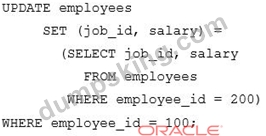
Which two statements are true? (Choose two.)
- A. Employee 100 will have SALARY set to the same value as the SALARY of employee 200
- B. Employee 200 will have JOB_ID set to the same value as the JOB_ID of employee 100
- C. Employee 100 will have JOB_ID set to the same value as the JOB_ID of employee 200
- D. Employee 200 will have SALARY set to the same value as the SALARY of employee 100
- E. Employees 100 and 200 will have the same JOB_ID as before the update command
- F. Employees 100 and 200 will have the same SALARY as before the update command
Answer: A,B
NEW QUESTION 64
You want to write a query that prompts for two column names and the WHERE condition each time it is executed in a session but only prompts for the table name the first time it is executed.
The variables used in your query are never undefined in your session.
Which query can be used?
SELECT &&col1, &&col2
- A. FROM &table
WHERE &&condition = &&cond;
SELECT &col1, &col2 - B. FROM &table
WHERE '&&condition' = '&cond';
SELECT &&col1, &&col2 - C. FROM &table
WHERE &&condition; - D. FROM &&table
WHERE &condition;
SELECT &col1, &col2 - E. FROM "&table"
WHERE &condition;
SELECT '&&col1', '&&col2'
Answer: D
NEW QUESTION 65
Which three statements are true about inner and outer joins? (Choose three.)
- A. Outer joins can only be used between two tables per query
- B. An inner join returns matched rows
- C. A full outer join must use Oracle syntax
- D. Outer joins can be used when there are multiple join conditions on two tables
- E. A full outer join returns matched and unmatched rows
- F. A left or right outer join returns only unmatched rows
Answer: B,E,F
Explanation:
Explanation/Reference: https://www.studytonight.com/dbms/joining-in-sql.php
NEW QUESTION 66
Which three statements are true about inner and outer joins? (Choose three.)
- A. Outer joins can only be used between two tables per query
- B. An inner join returns matched rows
- C. A full outer join must use Oracle syntax
- D. Outer joins can be used when there are multiple join conditions on two tables
- E. A full outer join returns matched and unmatched rows
- F. A left or right outer join returns only unmatched rows
Answer: B,E,F
Explanation:
Reference:
https://www.studytonight.com/dbms/joining-in-sql.php
NEW QUESTION 67
Examine the description of the CUSTOMERS table: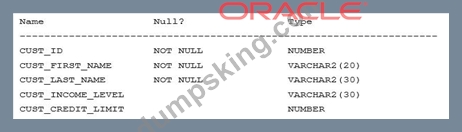
For customers whose income level has a value, you want to display the first name and due amount as 5% of their credit limit. Customers whose due amount is null should not be displayed.
Which query should be used?
- A. SELECT cust_first_name, cust_credit_limit * .05 AS DUE_AMOUNTFROM customersWHERE cust_income_level IS NOT NULLAND cust_credit_limit IS NOT NULL;
- B. SELECT cust_first_name, cust_credit_limit * .05 AS DUE_AMOUNTFROM customersWHERE cust_income_level IS NOT NULLAND due_amount IS NOT NULL;
- C. SELECT cust_first_name, cust_credit_limit * .05 AS DUE_AMOUNTFROM customersWHERE cust_income_level != NULLAND due_amount != NULL;
- D. SELECT cust_first_name, cust_credit_limit * .05 AS DUE_AMOUNTFROM customersWHERE cust_income_level <> NULLAND due_amount <> NULL;
- E. SELECT cust_first_name, cust_credit_limit * .05 AS DUE_AMOUNTFROM customersWHERE cust_income_level != NULLAND cust_credit_level !=NULL;
Answer: A
NEW QUESTION 68
Examine this command: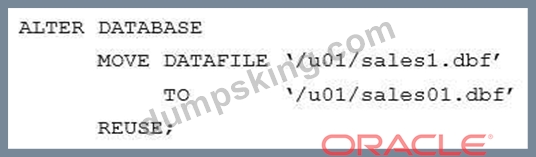
Which two statements are true? (Choose two.)
- A. If Oracle Managed Files (OMF) is used, then the file is renamed but moved to DB_CREATE_FILE_DEST.
- B. DML may be performed on tables with one or more extents in this data file during the execution of this command.
- C. The tablespace containing SALES1.DBF must be altered OFFLINE before executing the command.
- D. The tablespace containing SALES1.DBF must be altered READ ONLY before executing the command.
- E. The file is renamed and stored in the same location
Answer: B,D
NEW QUESTION 69
Which three statements are true about single-row functions? (Choose three.)
- A. The argument can be a column name, variable, literal or an expression
- B. They can accept only one argument
- C. They return a single result row per table
- D. The data type returned can be different from the data type of the argument
- E. They can be used only in the WHERE clause of a SELECT statement
- F. They can be nested to any level
Answer: A,C,D
NEW QUESTION 70
You want to apply the principle of Least Privilege in all your live databases.
One of your requirements is to revoke unnecessary privileges from all users who have them using Privilege Analysis.
Which three types of analyses can be done using the DBMS_PRIVILEGE_CAPTURE package?
(Choose three.)
- A. analysis of privileges granted directly to a role that are then used by a user who has been granted that role
- B. analysis of privileges that a user has on their own schema objects that they did not use
- C. analysis of all privileges used by all users but excluding administrative users in the database
- D. analysis of privileges that a user has on their own schema objects that they did use
- E. analysis of all privileges used by all users including administrative users in the database
- F. analysis of privileges granted indirectly to a role that are then used by a user who has been granted that role
Answer: B,E,F
Explanation:
https://docs.oracle.com/database/121/ARPLS/d_priv_prof.htm#ARPLS74328
NEW QUESTION 71
Examine these commands: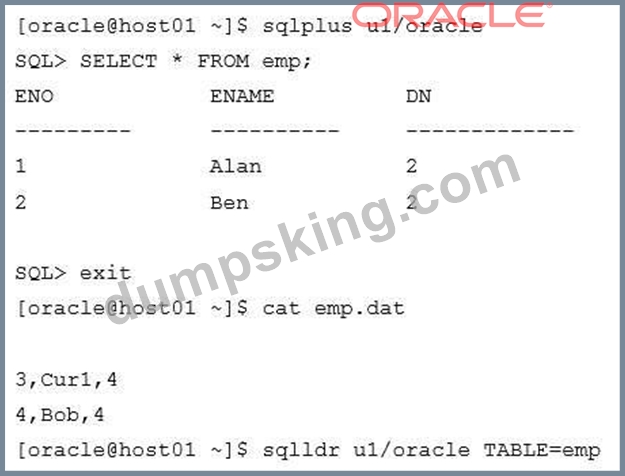
Which two statements are true about the sqlldrexecution? (Choose two.)
- A. It overwrites data in EMP with data in EMP.DAT
- B. It generates a log that contains control file entries, which can be used with normal SQL*Loader operations
- C. It uses the database buffer cache to load data
- D. It generates a sql script that it uses to load data from EMP.DAT to EMP
- E. It appends data from EMP.DAT to EMP
Answer: C,D
NEW QUESTION 72
Which three Oracle database space management features will work with both Dictionary and Locally managed tablespaces? (Choose three.)
- A. Oracle Managed Files (OMF)
- B. Online index segment shrink
- C. Automatic data file extension (AUTOEXTEND)
- D. Capacity planning growth reports based on historical data in the Automatic Workload Repository (AWR)
- E. Online table segment shrink
Answer: A,C,D
NEW QUESTION 73
Which three statements are true about a self-join? (Choose three.)
- A. The ON clause can be used
- B. It must be an inner join
- C. The ON clause must be used
- D. It must be an equi join
- E. It can be an outer join
- F. The query must use two different aliases for the table
Answer: A,B,F
NEW QUESTION 74
Which two statements are true about the PMON background process? (Choose two.)
- A. It records checkpoint information in the control file
- B. It kills sessions that exceed idle time
- C. It frees resources held by abnormally terminated processes
- D. It registers database services with all local and remote listeners known to the database instance
- E. It frees unused temporary segments
Answer: B,C
Explanation:
Reference:
https://docs.oracle.com/cd/B19306_01/server.102/b14220/process.htm
* Performs process recovery when a user process fails - Cleans up the database buffer cache - Frees resources that are used by the user process * Monitors sessions for idle session timeout
NEW QUESTION 75
Which two statements are true about trace files produced by the Oracle Database server?
(Choose two.)
- A. They can be written by server processes
- B. They can be written by background processes
- C. Trace file names are based on the database name concatenated with a sequential number
- D. Trace files are written to the Fast Recovery Area (FRA)
- E. All trace files contain error information that require contacting Oracle Support
Answer: A,B
Explanation:
https://gerardnico.com/db/oracle/trace_file
NEW QUESTION 76
Which three are types of segments in an Oracle Database? (Choose three.)
- A. stored procedures
- B. tables
- C. sequences
- D. clusters
- E. undo
- F. index
Answer: B,D,F
Explanation:
Explanation/Reference: http://www.adp-gmbh.ch/ora/concepts/segments.html
NEW QUESTION 77
Evaluate these commands which execute successfully: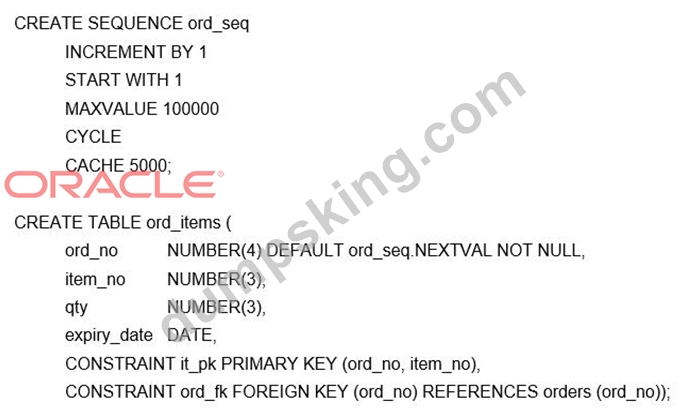
Which two statements are true about the ORD_ITEMS table and the ORD_SEQ sequence? (Choose two.)
- A. Sequence ORD_SEQ cycles back to 1 after every 5000 numbers and can cycle 20 times
- B. Any user inserting rows into table ORD_ITEMS must have been granted access to sequence ORD_SEQ
- C. If sequence ORD_SEQ is dropped then the default value for column ORD_NO will be NULL for rows inserted into ORD_ITEMS
- D. Column ORD_NO gets the next number from sequence ORD_SEQ whenever a row is inserted into ORD_ITEMS and no explicit value is given for ORD_NO
- E. Sequence ORD_SEQ is guaranteed not to generate duplicate numbers
Answer: B,E
NEW QUESTION 78
In one of your databases, user KING is:
1. Not a DBA user
2. An operating system (OS) user
Examine this command and its output:
What must you do so that KING is authenticated by the OS when connecting to the database instance?
- A. Set OS_AUTHENT_PREFIX to OPS$
- B. Grant DBA to KING
- C. Unset REMOTE_LOGIN_PASSWORDFILE
- D. Have the OS administrator add KING to the OSDBA group
- E. Alter user KING to be IDENTIFIED EXTERNALLY
Answer: C
NEW QUESTION 79
Which two statements are true about the Automatic Diagnostic Repository (ADR)? (Choose two.)
- A. The ADR base defaults to $ORACLE_HOME/rdbms/admin if neither DIAGNOSTIC_DEST nor ORACLE_BASE is set
- B. The ADR base defaults to $ORACLE_HOME/dbs if the DIAGNOSTIC_DEST parameter and the ORACLE_BASE environment variable are not set
- C. It supports diagnostics for Oracle Clusterware
- D. It supports diagnostics for Automatic Storage Management (ASM)
- E. It is held inside an Oracle database schema
Answer: A,E
Explanation:
https://docs.oracle.com/cd/E11882_01/install.112/e27508/admin.htm
NEW QUESTION 80
Examine the description of the CUSTOMERS table: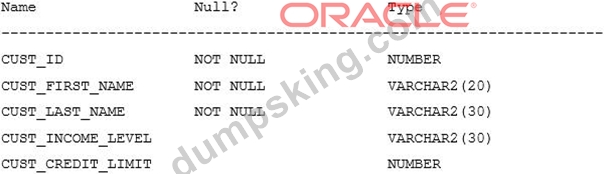
For customers whose income level has a value, you want to display the first name and due amount as 5% of their credit limit. Customers whose due amount is null should not be displayed.
Which query should be used?
- A. SELECT cust_first_name, cust_credit_limit * .05 AS DUE_AMOUNT FROM customers WHERE cust_income_level IS NOT NULL AND due_amount IS NOT NULL;
- B. SELECT cust_first_name, cust_credit_limit * .05 AS DUE_AMOUNT FROM customers WHERE cust_income_level != NULL AND cust_credit_level !=NULL;
- C. SELECT cust_first_name, cust_credit_limit * .05 AS DUE_AMOUNT FROM customers WHERE cust_income_level <> NULL AND due_amount <> NULL;
- D. SELECT cust_first_name, cust_credit_limit * .05 AS DUE_AMOUNT FROM customers WHERE cust_income_level IS NOT NULL AND cust_credit_limit IS NOT NULL;
- E. SELECT cust_first_name, cust_credit_limit * .05 AS DUE_AMOUNT FROM customers WHERE cust_income_level != NULL AND due_amount != NULL;
Answer: D
NEW QUESTION 81
......
1Z0-082 Dumps - Pass Your Certification Exam: https://www.dumpsking.com/1Z0-082-testking-dumps.html
Latest Real Oracle 1Z0-082 Exam Dumps Questions: https://drive.google.com/open?id=1I-Pa4hPYkFTJYiC1Qc9GY6VjjPh65P7Z
